
Most cover letters never get read. They're too long, sound like everyone else's, or trip up an ATS (Applicant Tracking System, the software that screens applications before a human ever sees them) before a recruiter lays eyes on them. In fact, 71% of cover letters exceed one page, which is an instant red flag for busy hiring teams. If you're an early-career professional or an active job seeker, the gap between a letter that gets ignored and one that lands an interview often comes down to a handful of fixable mistakes. This guide walks you through exactly what to fix, what to write, and how to use today's tools to your advantage.
Table of Contents
- Understand what recruiters actually want
- Structure your cover letter for impact and ATS success
- Personalize every letter: avoid clichés and generic content
- Proofread, get feedback, and use technology wisely
- An honest look: what actually works and what's just hype
- Build standout cover letters with ZapResume AI
- Frequently asked questions
Key Takeaways
| Point | Details |
|---|---|
| Personalize each letter | Tailor your content to the job and company requirements for best results. |
| Keep it concise | Stick to 250-400 words using a focused, three-to-four paragraph structure. |
| Show achievements | Lead with specific, quantified examples instead of generic statements. |
| Avoid errors | Proofread carefully and use feedback or AI tools to catch mistakes. |
Understand what recruiters actually want
Let's be direct: recruiters are not reading your cover letter the way your college professor read your essays. They're scanning. Recruiters skim cover letters in about 30 seconds, which means your value has to be front-loaded. If your strongest point is buried in paragraph three, it might as well not exist.
The good news? A well-crafted letter still carries real weight. 47% of recruiters consider cover letters very important, and candidates who submit personalized letters see 61% more interview callbacks. That's not a small edge. That's the difference between moving forward and getting filtered out.
ATS systems add another layer of complexity. These programs scan for relevance, structure, and keyword alignment before a human ever opens your file. A cover letter that reads naturally but also mirrors the language in the job description will consistently outperform one that's generic or keyword-stuffed.
"Your cover letter is not a summary of your resume. It's your argument for why you're the right fit for this specific role at this specific company."
Here's what recruiters actually want to see:
- A clear connection between your background and the role's requirements
- Specific achievements, not vague descriptions of responsibilities
- Concise language that respects their time (no filler phrases)
- Evidence of research showing you understand the company's goals or challenges
- A confident close that states your interest and invites next steps
If you're unsure whether your letter hits these marks, an AI cover letter generator can help you build a strong first draft that's already structured for recruiter and ATS appeal.
The biggest mistake most applicants make is treating the cover letter as a formality. Recruiters can tell when a letter was written in five minutes with a generic template. Personalization is not optional. It's the whole point.
Structure your cover letter for impact and ATS success
Understanding what matters to recruiters leads directly to the importance of structure. A cover letter without a clear structure is like a job interview where you ramble. Even if your content is strong, poor organization makes it hard to follow, and hard to follow means easy to discard.
The ideal cover letter follows a three-part structure: a hook that grabs attention, supporting evidence that backs up your claim, and a confident close that moves things forward. Recommended length is 250 to 400 words, organized into three to four short paragraphs. Going beyond one page puts you in the 71% who are already at a disadvantage.
Here's how to build it, step by step:
- Open with a specific hook. Name the role, state one concrete reason you're a strong fit, and make it interesting. Skip "I am writing to apply for..."
- Lead with a measurable achievement. In your first or second sentence, include a real number or result. "Increased client retention by 22%" is memorable. "Responsible for client relationships" is not.
- Connect your skills to their needs. Use language from the job description. If they say "cross-functional collaboration," use that phrase. ATS systems reward alignment.
- Keep each paragraph to two to four sentences. White space is your friend. Dense paragraphs signal poor communication skills.
- Close with a clear call to action. Express genuine enthusiasm, reference next steps, and thank them for their time.
| Element | Strong practice | Weak practice |
|---|---|---|
| Opening line | Role-specific, achievement-led | "I am writing to express my interest" |
| Length | 250 to 400 words, one page | Over 500 words, two pages |
| Paragraphs | 2 to 4 sentences each | 6 to 8 sentence blocks |
| Keywords | Mirrored from job description | Generic industry buzzwords |
| Closing | Confident, action-oriented | "I hope to hear from you" |
Pro Tip: Drop your most impressive, quantifiable result in the first paragraph. Recruiters who only skim the first few lines will still walk away with a strong impression of you.
You can also run your letter through an ATS resume checker to see how well it aligns with a specific job description before you hit send. If you want to understand how it works, the process takes seconds and gives you a real compatibility score.
Personalize every letter: avoid clichés and generic content
Once you've mastered structure, personalization becomes the key to real differentiation. This is where most applicants fall short, and the numbers back it up: 58% of cover letters are not customized to the job, and 62% contain errors. That means the majority of your competition is handing you an advantage if you're willing to do the work.
Generic phrases don't just fail to impress. They actively signal low effort. Phrases like "I am a hard worker," "I am passionate about this opportunity," or "I believe I would be a great fit" are so overused that recruiters mentally skip them. They add length without adding value.

Here's a quick comparison of what to avoid versus what actually works:
| Template phrase | Personalized rewrite |
|---|---|
| "I am a team player" | "At [Company], I led a cross-functional team of 6 to deliver a product launch 2 weeks ahead of schedule" |
| "I am passionate about marketing" | "Your recent pivot to community-led growth caught my attention, and it aligns with the strategy I used to grow an email list by 40%" |
| "I have strong communication skills" | "I translated complex technical specs into client-facing reports that reduced revision cycles by 30%" |
| "I would love to contribute to your team" | "I'd bring the same data-driven approach I used at [X] to help you hit your Q3 retention targets" |
To personalize effectively, research the company before you write a single word. Look at their recent news, LinkedIn posts, or product launches. Reference something specific. This shows you're not sending the same letter to 50 companies.
- Read the job description carefully and highlight the top three requirements
- Match each requirement to a specific example from your own experience
- Mention the company by name at least once, and reference something real about them
- Avoid adjectives that anyone could claim. Show, don't tell
Pro Tip: Reference a recent company milestone, campaign, or stated value in your opening paragraph. Even one specific detail signals genuine interest and separates your letter from the pile.
If you want a second opinion on whether your letter sounds generic, an AI resume checker can flag overused language and suggest stronger alternatives.
Proofread, get feedback, and use technology wisely
Even the best-crafted letter falls short if riddled with errors or lacks polish. Errors aren't just embarrassing. They're disqualifying. 62% of cover letters contain spelling mistakes, and a single typo in your opening paragraph can undo everything else you've done right.
Here's a step-by-step process to catch mistakes before they cost you:
- Read it aloud. Your ear catches what your eye misses. Awkward phrasing, run-on sentences, and missing words become obvious when spoken.
- Wait before you review. Write your draft, then come back to it after at least an hour. Fresh eyes spot errors faster.
- Use a grammar tool. Tools like Grammarly or Hemingway Editor catch surface errors and flag overly complex sentences.
- Run an ATS simulation. Paste your letter into an AI resume optimizer to check keyword alignment and readability before submitting.
- Get a peer review. Ask someone who works in your target industry, or a mentor, to read it. They'll catch tone issues and factual gaps you might miss.
On the topic of AI tools: they're genuinely useful, but only as a starting point. AI is useful for first drafts, but always personalize before sending. A letter that reads like it was generated by a bot is almost as damaging as a generic template. Use AI to get the structure right, then inject your own voice, specific achievements, and company-specific details.
Pro Tip: Build a small feedback group of two or three peers or mentors who can rotate reviewing your cover letters. Fresh perspectives catch blind spots you'll never see on your own, and the practice sharpens everyone's writing.
Explore the full range of ATS features available to job seekers who want to go beyond spellcheck and actually optimize their applications for modern hiring systems.
An honest look: what actually works and what's just hype
With these strategies in hand, it's worth reflecting on what really sets a winning cover letter apart. Here's the uncomfortable truth: the advice to "always write a cover letter" is not as universal as it sounds.
For some roles, especially high-volume entry-level positions, some recruiters rarely read cover letters at all. The resume does the heavy lifting. In those cases, a mediocre cover letter won't hurt you, but a great one won't help much either.
Where cover letters genuinely shift the odds is in competitive roles, writing-heavy positions, and career pivot scenarios. If you're changing industries, a cover letter is your only chance to explain the narrative behind your non-linear path. If you're applying to a communications or content role, your letter is itself a writing sample. These are the moments when a cover letter can be the deciding factor.
The other underrated truth? Human connection sometimes matters more than ATS optimization. A well-written email to a hiring manager that references a shared connection or a specific project can outperform a perfectly optimized letter submitted through a portal. Systems have limits. People respond to people. Check out cover letter insights to see how the best candidates balance both.
Build standout cover letters with ZapResume AI
Ready to apply what you've learned? ZapResume makes it fast and practical to put these strategies into action.
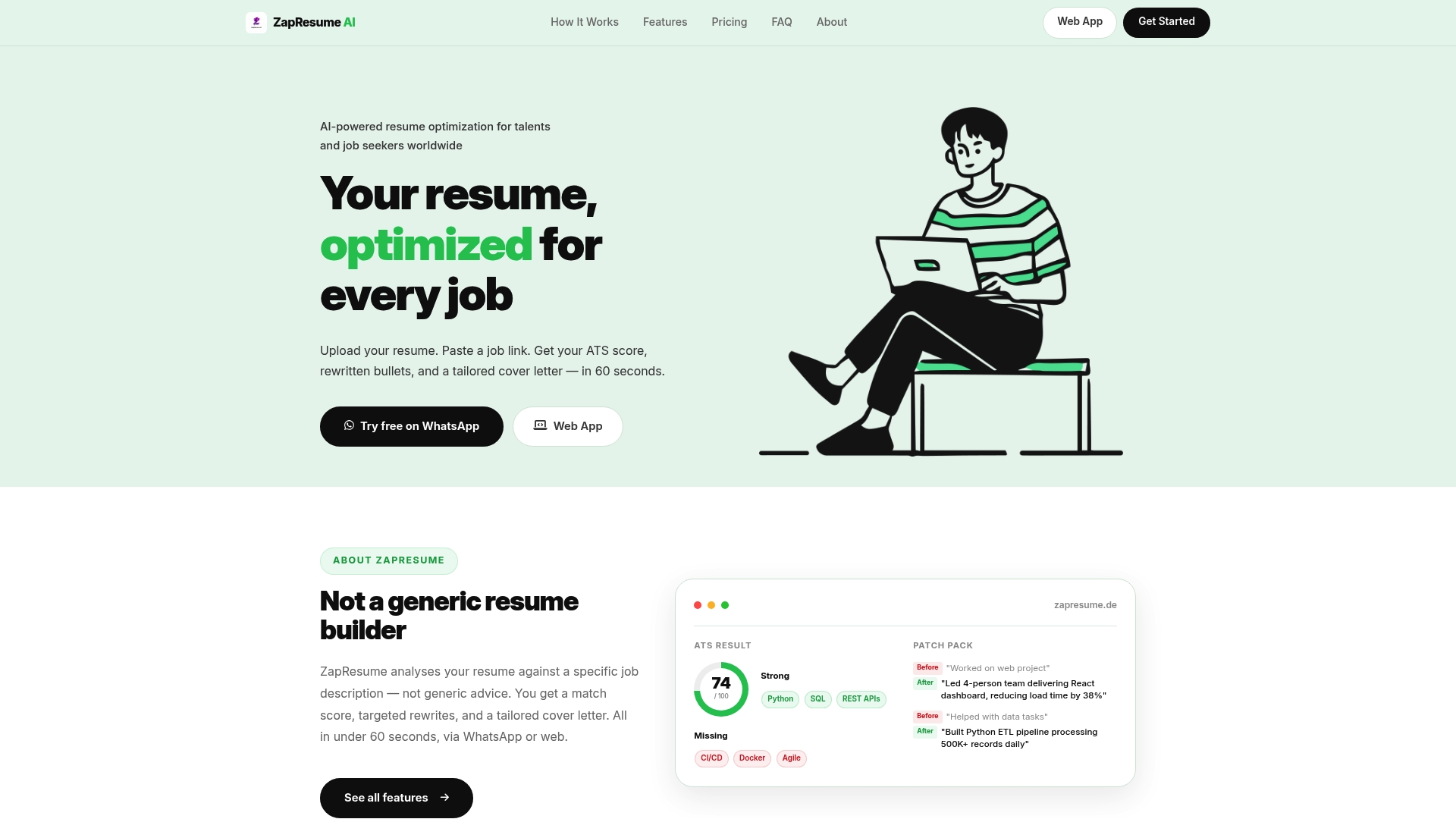
With ZapResume's AI cover letter generator, you get a structured, personalized first draft built around your target job description in seconds. No generic templates. No guesswork. The platform analyzes your resume and the job posting, then generates a letter that mirrors the right keywords and tone for that specific role. Pair it with the ATS resume checker to confirm your full application is optimized before you submit. Whether you're applying for your first job or making a strategic career move, ZapResume gives you the tools to compete at the highest level without spending hours on formatting and rewrites.
Frequently asked questions
How long should a cover letter be?
Aim for 250 to 400 words, organized into three to four short paragraphs. Anything longer risks losing the recruiter's attention before you make your case.
Do I need to write a cover letter if it's optional?
If you have context to add, such as a career change or a gap in your resume, submit one. Even optional cover letters boost interview chances when they add genuine value beyond what the resume shows.
What are the most common cover letter mistakes?
The biggest mistakes are typos, generic phrasing, and failing to tailor the letter to the role. 62% have spelling errors and 58% are not customized, which means these two fixes alone put you ahead of most applicants.
Do recruiters actually read cover letters?
It depends on the role and industry. Some recruiters rarely read them for high-volume positions, but for competitive or writing-focused roles, a strong cover letter can be the deciding factor in whether you move forward.