
You've sent out dozens of applications. Your resume looks clean, your experience is solid, and yet your inbox stays empty. The problem usually isn't your qualifications. It's alignment. Most resumes are written to summarize a career, not to answer a specific job posting. Hiring teams rely on ATS (Applicant Tracking System) software to filter candidates before any human ever reads a single line, and a generic resume almost always gets eliminated at that stage. This guide walks you through every step of matching your resume to the job description so you actually get called back.
Table of Contents
- Understand how automated systems screen your resume
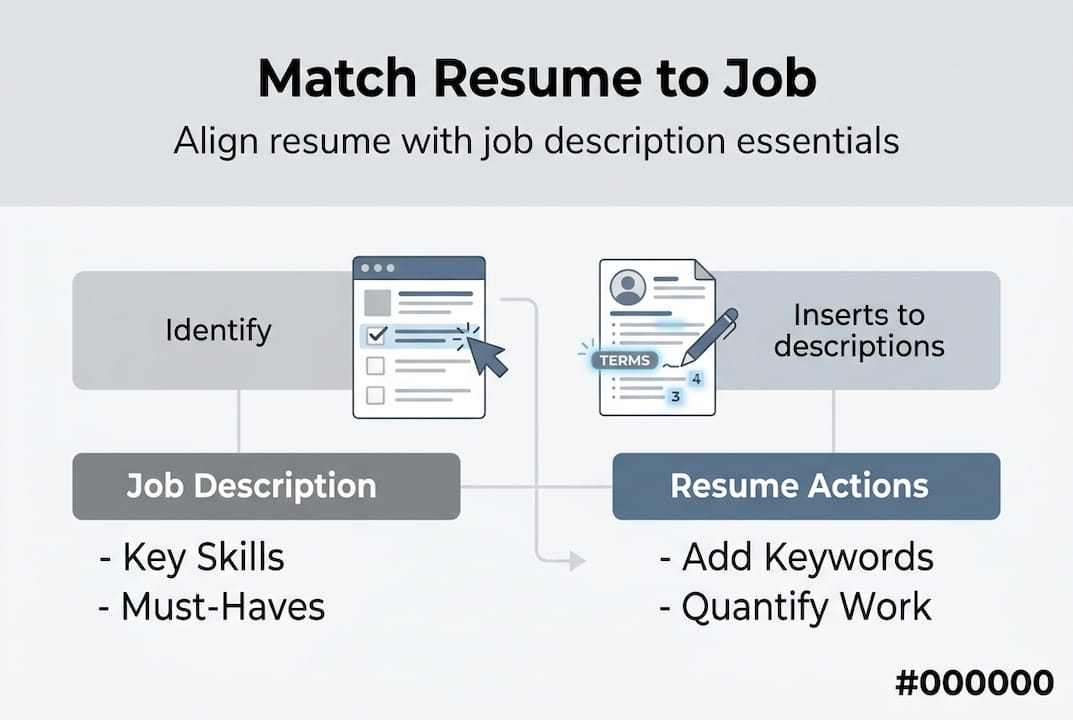
- Gather requirements from the job description
- Tailor your resume to fit the job exactly
- Use AI tools wisely and avoid common mistakes
- The hard truth about automated resume tailoring
- Accelerate your job search with ZapResume AI
- Frequently asked questions
Key Takeaways
| Point | Details |
|---|---|
| ATS systems demand context | Modern resume checkers look for natural alignment with job descriptions, not just keywords. |
| Dissect job descriptions | Break down the job ad to find essential skills and must-have requirements before you begin editing. |
| Tailoring beats repetition | Customizing each resume for the role greatly raises your chances of being screened in. |
| Use AI as a booster | AI tools help but shouldn't replace real human review and personalization. |
| Balance fit with authenticity | The best resumes mirror job descriptions while remaining genuinely representative of your experience. |
Understand how automated systems screen your resume
Before you can beat the system, you need to understand what you're up against. An ATS is software that parses your resume, extracts information, and scores it against the job description. Most large and mid-size companies use one. In fact, 83 to 99% of companies now rely on ATS or AI screening to manage high application volumes. That means your resume is being read by an algorithm before it reaches a recruiter.
Here's the part most candidates get wrong: modern ATS platforms don't just scan for exact keywords. They use semantic matching, which means they understand context. If the job description says "team leadership" and your resume says "managed a cross-functional group," a smart ATS may still connect the dots. But if your resume is stuffed with keywords that don't fit naturally into sentences, that same system may flag it as low quality.
Common ATS myths worth dropping:
- Myth: You need to copy-paste keywords word for word. Reality: Context and natural usage matter more.
- Myth: Fancy formatting helps you stand out. Reality: Complex tables and graphics often break ATS parsing.
- Myth: A longer resume scores higher. Reality: Relevance beats length every time.
- Myth: One resume works for all jobs. Reality: Each posting has unique requirements that your resume must reflect.
Using an ATS resume checker before you submit can reveal exactly where your resume falls short against a specific job description.
| ATS feature | What it does | Your optimization strategy |
|---|---|---|
| Keyword parsing | Extracts skills and terms | Use natural, role-relevant language |
| Semantic matching | Understands meaning, not just words | Write in context, not keyword lists |
| Format scanning | Reads layout and structure | Use clean, single-column formatting |
| Scoring | Ranks candidates by fit | Tailor each resume to each role |
| Experience mapping | Matches job titles and dates | Be specific about roles and timelines |
The takeaway is simple: write for humans first, but structure for machines. A resume that reads naturally and uses role-relevant language will outperform a keyword-stuffed document every single time.
Gather requirements from the job description
Understanding how screening works, your next move is to study the actual job post. Not skim it. Study it. Job descriptions are written by people who know exactly what they need, and every word is a signal.
Start with these sections of any job posting:
- Job title and summary: This sets the overall framing. Mirror the title language in your resume headline.
- Responsibilities: These tell you what you'll actually do. Your experience bullets should reflect these tasks directly.
- Required qualifications: Non-negotiables. If you have them, they must appear clearly on your resume.
- Preferred qualifications: Nice-to-haves. Include them if you have them, but don't fabricate.
- Company values or culture notes: These reveal the tone and language the employer uses internally.
| Requirement type | Example | Resume action |
|---|---|---|
| Must-have | "5 years in project management" | Feature this prominently in experience |
| Must-have | "Proficiency in SQL" | List under skills, reinforce in bullets |
| Nice-to-have | "Experience with Agile" | Include if true, lower priority |
| Nice-to-have | "MBA preferred" | Mention in education if applicable |
Sometimes job descriptions are vague or use unfamiliar internal titles. When that happens, research similar roles on LinkedIn or industry job boards to understand what skills and responsibilities typically apply. Career changers should pay special attention here: look for the transferable skills buried in your past roles that match the new field's language.
Pro Tip: Copy the job description into a plain text document and highlight every skill, tool, and responsibility mentioned more than once. Those repeated terms are the employer's true priorities. Make sure your resume addresses each one directly.
Understanding how resume optimization works can also help you see which elements of a job description carry the most weight in scoring systems.
Tailor your resume to fit the job exactly
With your requirements identified, it's time for the practical work of customizing your resume. This is where most candidates stop short. They update a bullet point or two and call it done. Real tailoring goes deeper.
Follow these steps for every application:
- Scan the job description one more time. Identify the top five skills or outcomes the employer is asking for.
- Mirror their language. If they say "stakeholder communication," use that phrase. Don't substitute "talking to clients" and hope the ATS connects them.
- Reorder your experience bullets. Put the most relevant accomplishments at the top of each role section, not the most recent task.
- Quantify everything you can. Numbers make accomplishments real. "Increased sales by 34%" is stronger than "improved sales performance."
- Address must-haves directly. Every required qualification should appear somewhere on your resume, ideally with evidence.
"Recruiters value outcomes over duties. Tailoring your resume signals genuine effort to human reviewers after it clears the ATS filter."
Quantified bullets consistently outperform vague duty lists because they give both the algorithm and the recruiter something concrete to evaluate. Think of each bullet as a mini case study: here's what I did, here's how I did it, and here's what happened.

Pro Tip: If you're a career changer or a senior professional, focus on transferable skills and frame them using the job description's exact vocabulary. Seniors should also trim their resume to two pages to avoid keyword dilution across too many older, less relevant roles.
A good resume optimizer tool can speed up this process by automatically identifying gaps between your resume and the job description, so you know exactly what to fix.
Use AI tools wisely and avoid common mistakes
After you've made tailored edits, technology can help, but only if you use it strategically. AI resume tools can extract key requirements from job descriptions, suggest stronger phrasing, and flag missing keywords in seconds. That's genuinely useful. But there's a catch.
Recruiters are getting better at spotting generic AI phrasing. Phrases like "results-driven professional with a passion for excellence" or "dynamic team player with proven leadership" read as filler. They say nothing specific and they appear on thousands of resumes. If your AI tool produces language like that, delete it.
Red flags that make a resume look generic or AI-written:
- Vague superlatives with no evidence ("exceptional communicator")
- Identical sentence structures throughout every bullet point
- Buzzwords that don't connect to actual accomplishments
- No numbers, no specifics, no named tools or systems
- A summary paragraph that could belong to anyone in any industry
Some recruiters also flag resumes that seem over-tailored or artificially polished, which is why balance matters. The goal is a resume that reads like a sharp, focused human wrote it with full knowledge of the role, not one that reads like it was assembled by a machine.
Use an AI resume checker to catch gaps and scoring issues, but always do a final manual pass before submitting.
Pro Tip: Read your resume out loud before sending it. If any sentence sounds unnatural or robotic, rewrite it in your own voice. Authenticity is not just a soft concept. It's what separates memorable candidates from forgettable ones.
The hard truth about automated resume tailoring
Here's what most resume guides won't tell you: a perfectly optimized resume can actually work against you. When every bullet point is engineered to hit a keyword and every phrase mirrors the job description exactly, the result can feel hollow. Recruiters who read dozens of resumes a day develop a sharp instinct for candidates who are performing fit versus candidates who actually have it.
The most successful job seekers we see aren't the ones who score 100% on every ATS check. They're the ones who use the job description as a translation tool. They take their real experience and tell it in the employer's language. That's a fundamentally different mindset than trying to trick a system.
Over-optimization is a real risk. If your resume sounds like it was written by the job description itself, it raises a quiet question in the recruiter's mind: does this person actually know what they're talking about, or did they just copy our words back to us? The resume features that matter most are the ones that preserve your authentic story while making it legible to both machines and humans.
Tailor strategically. Verify carefully. But never lose the real you in the process.
Accelerate your job search with ZapResume AI
Putting all of this into practice takes time, especially when you're applying to multiple roles at once. ZapResume AI is built specifically to close that gap. Upload your resume and a job description, and within seconds you get a real-time ATS compatibility score, semantic skill matching, and concrete rewrite suggestions tailored to that exact role.
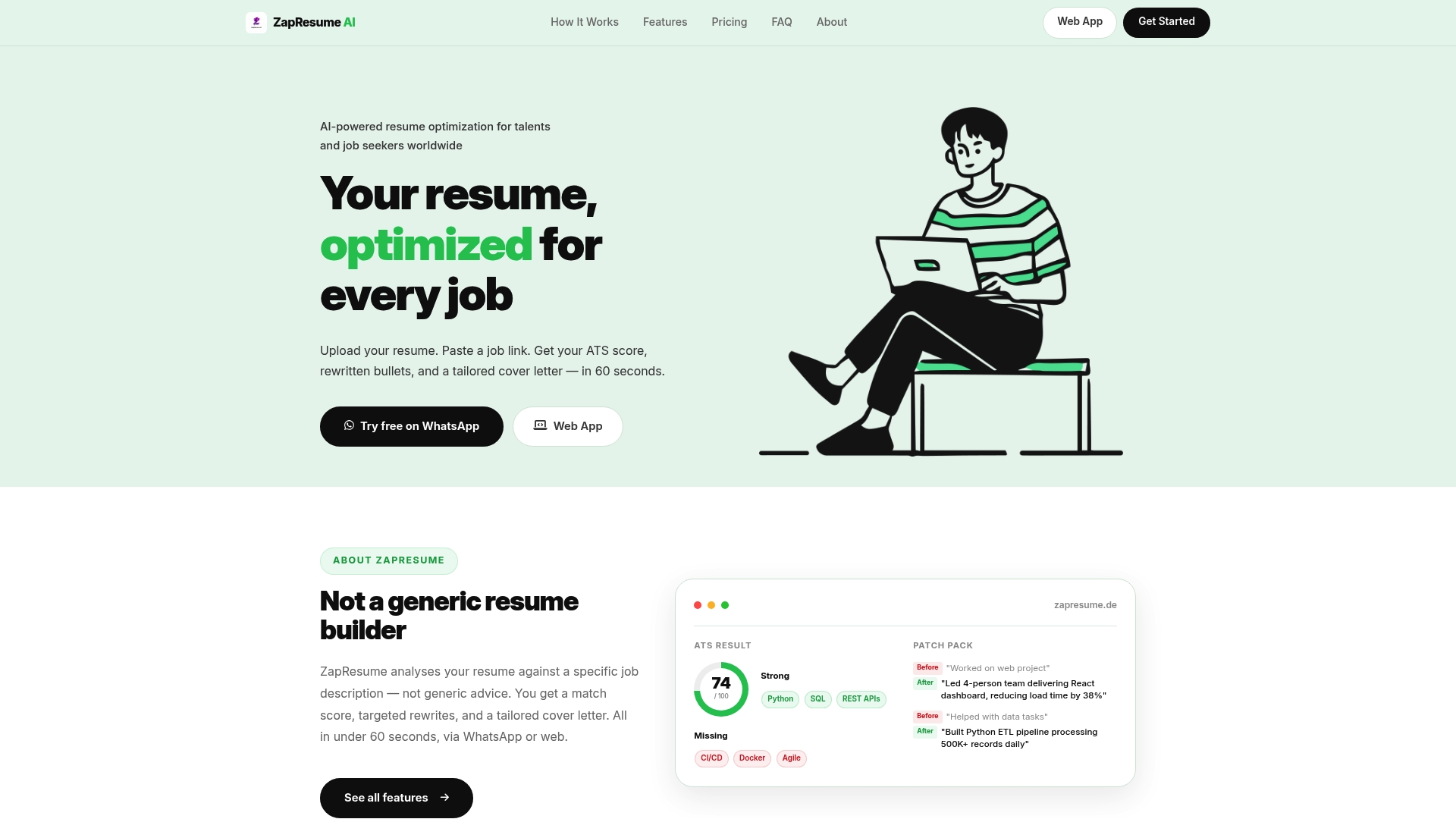
You can also run your resume through the ATS Resume Checker to see exactly where you're losing points, and generate a personalized cover letter with the AI Cover Letter Generator that matches the tone and requirements of the job. No downloads, no account required to get started. Just faster, smarter applications.
Frequently asked questions
What is the single most important thing to match on a resume?
The most critical elements to mirror are the essential skills and requirements listed in the job description, using the employer's own language where possible. These are the signals both ATS and human reviewers are looking for first.
Will matching keywords guarantee my resume gets seen?
Keyword matching is necessary, but modern ATS use semantic matching beyond exact terms, so natural alignment within context is more effective than forcing keywords into every sentence.
Can I use the same resume for different jobs?
You risk being filtered out by both ATS and hiring managers if you don't tailor your resume, since a one-size-fits-all resume fails to address the unique priorities of each role.
Is it okay to use AI to rewrite my resume?
AI tools are helpful for identifying gaps and improving phrasing, but always review AI output manually to ensure your resume stays truthful, specific, and written in your own voice.
How can career changers match their experience to a new field?
Identify your transferable skills and use the job description's keywords to frame how your past achievements apply, since highlighting transferable skills in the employer's language is the most effective bridge between industries.