
You could have exactly the right experience for a job and still never hear back. That's the reality for thousands of qualified candidates every week. Most resumes are filtered out by automated software before a human ever reads them, not because the applicant lacks skills, but because their resume doesn't speak the right language. Matching your resume to specific job requirements is no longer optional; it's the single most important thing you can do to increase your interview rate. This guide walks you through exactly how to do it, with research-backed strategies that work.
Table of Contents
- Why matching job requirements matters
- Understanding job requirements and their role
- How to tailor your resume to the job description
- ATS systems and common mistakes to avoid
- Why most advice about matching job requirements misses the mark
- Optimize your resume for every job with ZapResume AI
- Frequently asked questions
Key Takeaways
| Point | Details |
|---|---|
| ATS filters matter | Most resumes never reach recruiters because they do not match job requirements well enough for ATS screening. |
| Keyword optimization boosts fit | Tailoring your resume with relevant keywords can instantly increase your match score by 28 percentage points. |
| Action beats experience alone | Even with strong experience, your resume must align with each job's requirements for better chances. |
| Use AI for instant feedback | AI tools quickly identify gaps and help you align your resume with specific postings. |
Why matching job requirements matters
Let's be direct: submitting a generic resume to every job posting is one of the fastest ways to stay unemployed. Companies today use Applicant Tracking Systems, or ATS, to screen applications before a recruiter ever opens them. These systems scan your resume for specific keywords, phrases, and qualifications that match the job description. If your resume doesn't reflect those requirements closely enough, it gets filtered out automatically.
The numbers here are striking. Research shows that AI keyword optimization can boost resume fit scores by 28 percentage points instantly, without fabricating experience or skills. That's a massive jump from a targeted, strategic edit.
"AI tools boost fit scores +28pp instantly via keyword optimization without fabrication." This means the gap between getting filtered out and getting noticed is often just a matter of language alignment, not qualifications.
Here's why this matters beyond just passing a filter:
- Recruiters spend seconds on each resume. If your resume doesn't mirror the job's language, it won't register, even on a human read.
- ATS systems are literal. They look for exact or near-exact matches to the job description's terms. "Project coordination" and "project management" may not score the same.
- Higher fit scores signal relevance. Recruiters using ATS dashboards often sort candidates by fit score. A higher score means you appear earlier and more prominently.
- Tailored resumes show effort. Hiring managers can tell when a resume has been customized. It communicates professionalism and genuine interest.
Using an AI resume checker to measure how well your resume aligns with a specific job description gives you a concrete starting point. Instead of guessing, you get a real score and specific gaps to address.
The bottom line is simple: your resume needs to reflect the job's language, not just your career history. Having set the stage for why this matters, let's look at what job requirements really are.
Understanding job requirements and their role
Job requirements are the criteria employers use to decide who gets screened in and who gets screened out. They typically include required skills, years of experience, educational qualifications, and certifications. But there's more to it than just the "Required" section of a job posting.
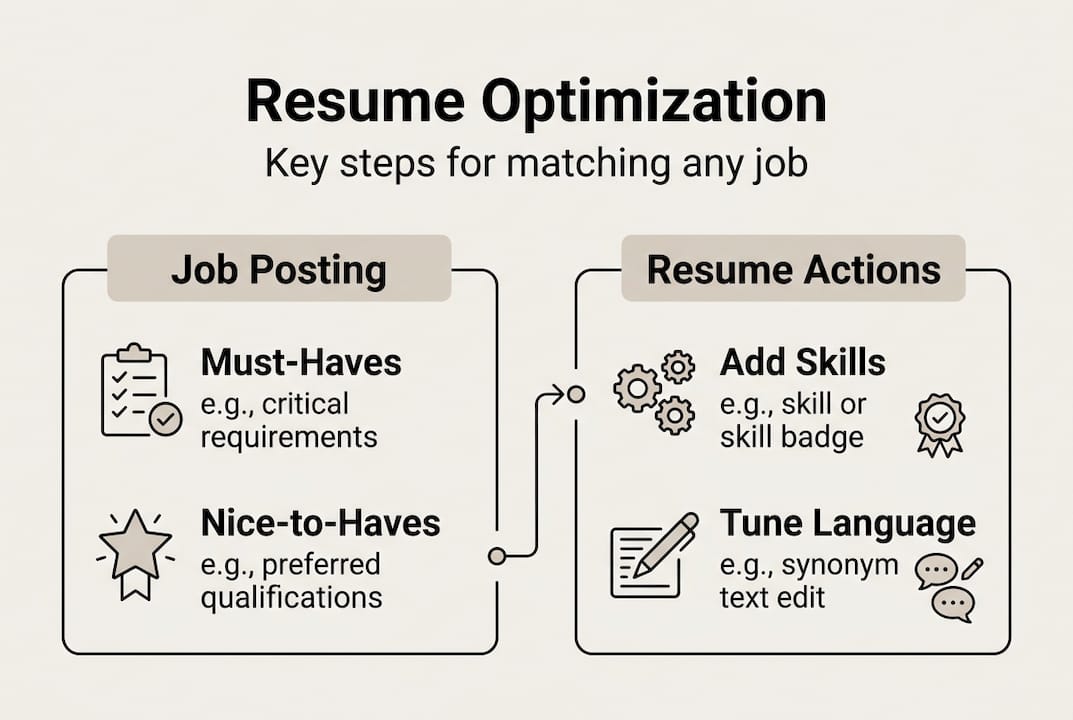
Job postings contain two layers of requirements. The first layer is explicit requirements: the must-haves listed clearly in the posting. The second layer is implicit or preferred requirements: the "nice to have" skills, tools, or experiences that don't disqualify you if missing, but absolutely help if present. Both layers matter for ATS scoring and recruiter evaluation.

Here's a breakdown of where to find each type:
| Requirement type | Where to find it | ATS impact |
|---|---|---|
| Required skills | "Requirements" or "Qualifications" section | Very high |
| Preferred skills | "Nice to have" or "Preferred" section | Moderate to high |
| Responsibilities | Job duties listed in the posting | Moderate |
| Certifications | Specific tools or credentials listed | High if listed |
The AI keyword optimization research confirms that addressing both required and preferred skills significantly improves fit scores. Ignoring the preferred column is a missed opportunity most candidates don't realize they're leaving on the table.
Here's a simple process to extract all relevant requirements from any job posting:
- Copy the entire job description into a document.
- Highlight every skill, tool, certification, and qualification mentioned.
- Separate them into "required" and "preferred" columns.
- Compare each item against your current resume.
- Identify gaps and plan how to address them honestly.
Pro Tip: Don't just scan the "Requirements" section. Read the full job posting, including the responsibilities and company description. Employers often embed key skills in the duties list without labeling them as requirements.
Using a resume optimizer tool can automate this comparison and surface gaps you might miss manually. Once you know what requirements matter, the next step is tailoring your resume to them.
How to tailor your resume to the job description
Tailoring your resume isn't about rewriting it from scratch for every application. It's about making targeted, strategic edits that align your existing experience with the specific language and priorities of each job posting.
Here's a side-by-side look at a generic versus tailored resume approach:
| Resume element | Generic approach | Tailored approach |
|---|---|---|
| Summary | Broad career overview | Mirrors job title and top 2-3 required skills |
| Skills section | Fixed list of all skills | Reordered to match job's priority skills |
| Experience bullets | Task-focused descriptions | Outcome-focused, using job's exact terminology |
| Keywords | Inconsistent, general | Directly pulled from job description |
The +28pp fit improvement from AI keyword optimization shows just how much targeted language changes the outcome. This isn't about gaming the system. It's about communicating clearly in the language the employer is already using.
Follow these steps to tailor your resume effectively:
- Start with your summary. Rewrite it to reflect the job title and the top skills listed in the posting.
- Adjust your skills section. Move the most relevant skills to the top and add any missing ones you genuinely have.
- Rewrite experience bullets. Use the job's exact phrasing where it honestly applies to your past work.
- Add missing keywords. If the job mentions a tool or methodology you've used but haven't listed, add it.
- Review formatting. Make sure your resume is clean, ATS-friendly, and free of tables or graphics that confuse parsing software.
Pro Tip: Avoid keyword stuffing. Dropping the same term ten times doesn't help and can actually hurt your score. Weave required terms naturally into your summary, experience bullets, and skills section, once or twice each in context.
The step-by-step AI optimization process at ZapResume handles this analysis instantly, showing you exactly which keywords to add and where. You've seen how to tailor your resume, but how does ATS technology factor in and what are the pitfalls to avoid?
ATS systems and common mistakes to avoid
ATS software doesn't read your resume the way a human does. It parses text, extracts data, and scores your application based on how well it matches the job description's requirements. Understanding this helps you avoid the mistakes that silently kill applications.
The most common ATS errors candidates make include:
- Using graphics, charts, or text boxes. ATS software often can't parse these elements, meaning key information disappears entirely.
- Submitting in the wrong format. Some ATS systems struggle with PDFs. A clean .docx file is often safer unless the posting specifies otherwise.
- Using creative job titles. If your actual title was "Growth Ninja" but the job asks for "Marketing Manager," the ATS won't connect them. Use standard industry titles in your resume where appropriate.
- Ignoring job-specific language. Using synonyms when the job description uses specific terms is a common and costly mistake.
- Keyword stuffing. Overloading your resume with repeated keywords can trigger spam filters in some ATS platforms.
Research shows that AI-driven fit score improvements of up to 28 percentage points are achievable through strategic keyword alignment, making it one of the highest-impact changes a job seeker can make.
Formatting matters as much as content. Use standard section headings like "Work Experience," "Education," and "Skills." Avoid headers and footers for critical information, since many ATS systems skip those areas entirely.
You can check your resume's ATS compatibility using an ATS resume checker before submitting. This gives you a real-time score and flags specific issues to fix. Exploring the full range of ATS scoring features available can also help you understand exactly how your resume is being evaluated at each stage. With a clear view on ATS systems and common errors, let's sum up how to bring everything together for greater job search success.
Why most advice about matching job requirements misses the mark
Here's an uncomfortable truth: most resume advice is surface-level. It tells you to "use keywords" and "customize your resume" without explaining what that actually means in practice or how to measure whether it's working.
The real problem is that most job seekers treat resume optimization as a one-time task. They tweak their resume once, send it out, and wait. But the job market gives you feedback every time you don't get a callback. The question is whether you're using that feedback or ignoring it.
Successful candidates treat resume optimization as an ongoing process. They test, measure, and iterate. They use AI-driven resume feedback to get real scores, not just gut feelings. They understand that a resume that worked for one role may score poorly for a slightly different one, even in the same industry.
The shift from "I have a good resume" to "I have a resume optimized for this specific job" is the difference between hoping and strategizing. AI tools have made this kind of precision accessible to everyone, not just candidates with professional resume writers on speed dial.
Optimize your resume for every job with ZapResume AI
You now have a clear picture of how ATS systems work, what job requirements really mean, and how to close the gap between your resume and what employers are actually looking for. The next step is putting that knowledge to work fast.
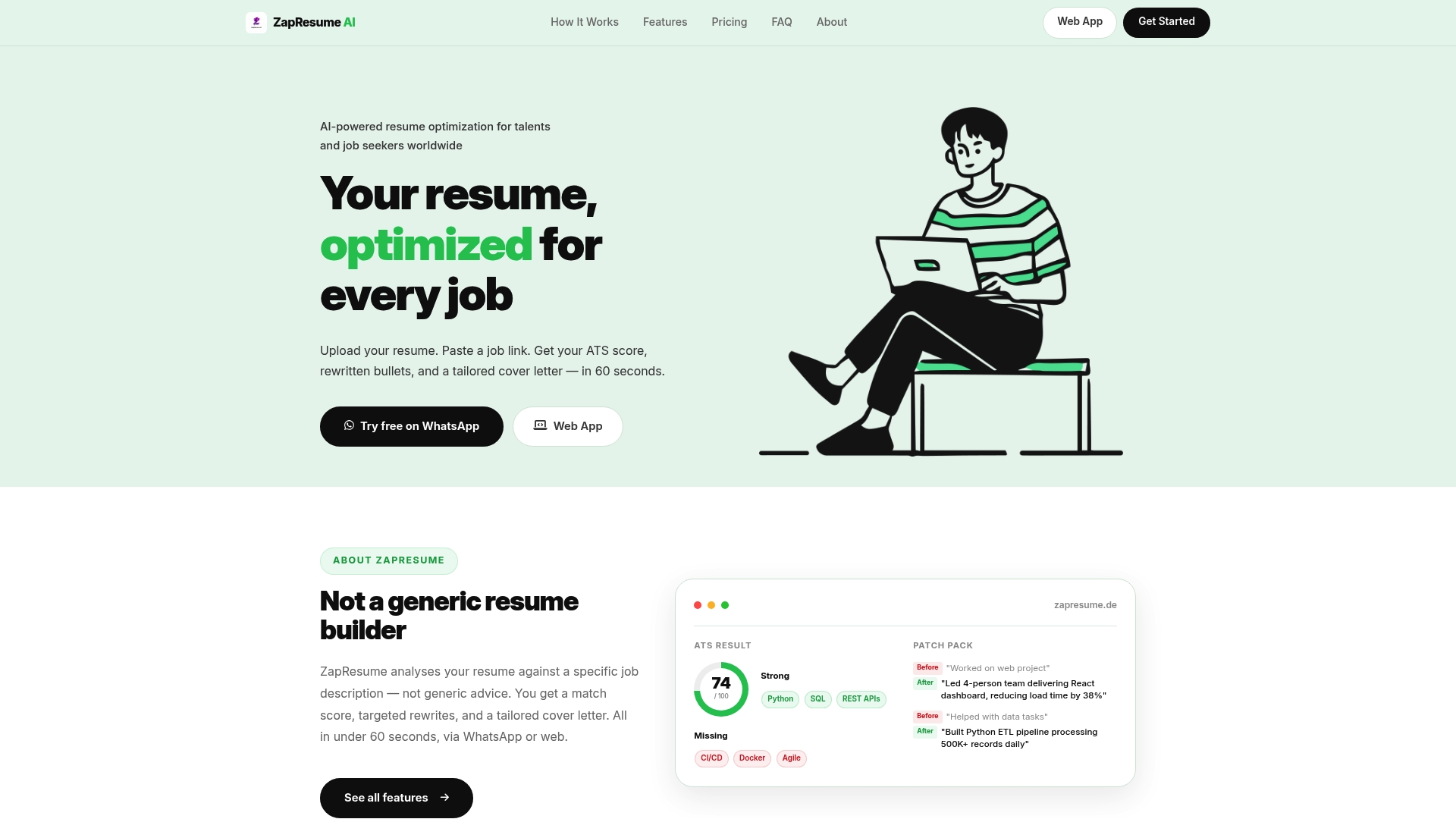
ZapResume AI gives you instant resume optimization built around the specific job you're applying for. Upload your resume, paste in the job description, and get a real-time ATS fit score along with targeted keyword suggestions. The AI resume optimizer identifies exactly what's missing and rewrites your bullet points to match. You can also generate a tailored cover letter with the AI cover letter generator in seconds. Check the full resume features overview to see everything available. No downloads, no account required to get started.
Frequently asked questions
What are the main reasons resumes are rejected by ATS?
Resumes are typically rejected for missing keywords, using unusual formatting like text boxes or graphics, or repeating keywords excessively in a way that triggers spam filters. Fixing these three issues alone can significantly increase your chances of passing the initial screen.
How can I quickly improve my resume's match rate?
Use AI optimization tools to align your resume's language with the job description. Research shows +28pp fit improvement is achievable through targeted keyword optimization, without inventing experience or skills you don't have.
Is it enough to match only the required skills in the job posting?
Matching only the required skills is a starting point, but addressing preferred and recommended skills as well maximizes your score with both ATS and human reviewers. Research confirms that both required and recommended skills directly influence fit scores.
What is the fastest way to check if my resume matches a job?
Run your resume through an ATS checker or AI optimizer for instant results. These tools provide instant fit scores via keywords and show you exactly which gaps to close before submitting your application.